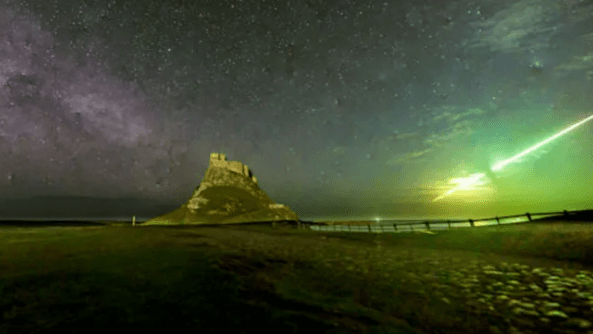
At 00:30 BST on April 13, 2026, a massive green fireball Britain residents won’t soon forget streaked across the sky—captured by doorbell cameras from Derbyshire to Northumberland. Hundreds of people saw it. Most of them thought someone had launched the world’s most ambitious rogue firework.
“I saw that. It was bright green. It was massive. I thought it was a firework at first; it seemed so close,” one viewer posted on Facebook.
Another said, “Yes, I saw it walking home in Derbyshire. Looked like a firework, the colors it was giving off. Glad I read this…wasn’t sure what I’d seen.”
One person joked: “Yep, my bathroom lit up, I thought I was hallucinating… lol”.
Turns out, it wasn’t a firework. It was a meteor—technically a bolide, which is NASA’s term for a fireball that explodes in the atmosphere.
What Happens When Space Rocks Hit the Atmosphere
During atmospheric entry, an object slows down and heats up by friction. A bow shock forms in front of it—atmospheric gases compress, heat up, and radiate energy back to the object, causing it to ablate (burn away).
Most of the time, the object breaks apart. Fragmentation increases the amount of atmosphere it intercepts, which enhances both ablation and braking. The object catastrophically disrupts when the force from unequal pressures on its front and back sides exceeds its tensile strength.
Translation: it blows up before it hits the ground.
In this case, the fireball disappeared after bursting into a bright green glow, suggesting that most of it burned up before reaching Earth.
Thousands of Fireballs Happen Daily—You Just Don’t See Them
Around the world, thousands of fireballs occur every day.
Most go unnoticed because they happen over oceans, uninhabited regions, or during daylight hours when the sky’s too bright to catch the show.
This one happened at half past midnight over a densely populated island with a doorbell camera on every other porch. So it got noticed.
Keith Spirit captured a photo of the fireball as it zoomed through the skies over Northumberland. Someone on the M62 was still buzzing about how bright it was. A camera on the edge of the moors in Winterburn caught it.
One person quipped: “See, we go round the moon, and now we have space rocks being thrown at us,” in reference to NASA’s Artemis II mission.
The Green Color Means Something
The bright green hue isn’t random—it’s caused by the composition of the meteor itself. When certain metals (such as nickel or magnesium) burn in the atmosphere, they emit green light.
So the color tells you what the rock was made of before it became a fleeting spectacle for insomniacs and late-night dog walkers.
The Difference Between a Meteor, a Meteoroid, and a Meteorite
- An asteroid is a large chunk of rock left over from collisions or the early solar system—most are located between Mars and Jupiter in the Main Belt.
- A comet is a rock covered in ice, methane, and other compounds, with orbits that take it much farther out of the solar system.
- A meteor is what astronomers call a flash of light in the atmosphere when debris burns up.
- The debris itself is known as a meteoroid. If any of that meteoroid makes it to Earth, it’s called a meteorite. Most are so small they vaporize in the atmosphere.
No One Got Hit by Space Debris This Time
The good news is the fireball disappeared, meaning it burned up before impact.
The bad news: if you were hoping to find a meteorite in your backyard and sell it on eBay, you’re out of luck.
Space rocks hit Earth all the time. Most of them are harmless. The ones that aren’t—well, those make the news for different reasons.
This one just lit up the sky, confused a few hundred people, and gave everyone something to talk about over breakfast.
Image credit: Ian Sproat/@mje_photography_ne)